Bringing a dog into a home with a cat, or vice-versa, can feel like you’re trying to broker a peace treaty between two warring nations. The constant chasing, barking, and tension can be incredibly stressful for you and your pets. But what if I told you that a calm, peaceful coexistence isn’t just a fantasy? It’s absolutely achievable! Many pet owners think they just have to live with the chaos, but with the right approach, you can teach your dog that the family cat is just a boring part of the furniture.
Forget the old adage ‘they fight like cats and dogs.’ We’re going to replace it with a new reality: ‘they coexist like calm, well-behaved roommates.’ This guide is designed to be your roadmap. We’ll break down the process into simple, manageable steps, focusing on safety, management, and positive reinforcement. Get ready to reclaim the peace in your home and build a foundation of mutual respect between your furry companions.
Setting the Stage for Success: Management and Safety First
Before you even think about formal training sessions, your number one priority is management. Management means arranging the environment to prevent unwanted interactions from happening in the first place. Every time your dog gets to chase the cat, that behavior is reinforced, making it much harder to train away. Think of this phase as creating a safe zone where everyone can relax without being on high alert.
Why Management is Non-Negotiable:
- Prevents Rehearsal of Bad Behavior: If the dog never gets the chance to chase, the chasing habit can’t become ingrained.
- Reduces Stress for Both Pets: Your cat needs to know it has safe spaces to escape to, and your dog needs to learn to be calm in the house. Constant tension is detrimental to their well-being.
- Builds a Foundation for Training: Training is nearly impossible if the environment is chaotic. A managed home creates the calm headspace needed for learning.
Your Management Toolkit:
Implementing these tools is the first practical step toward a peaceful home:
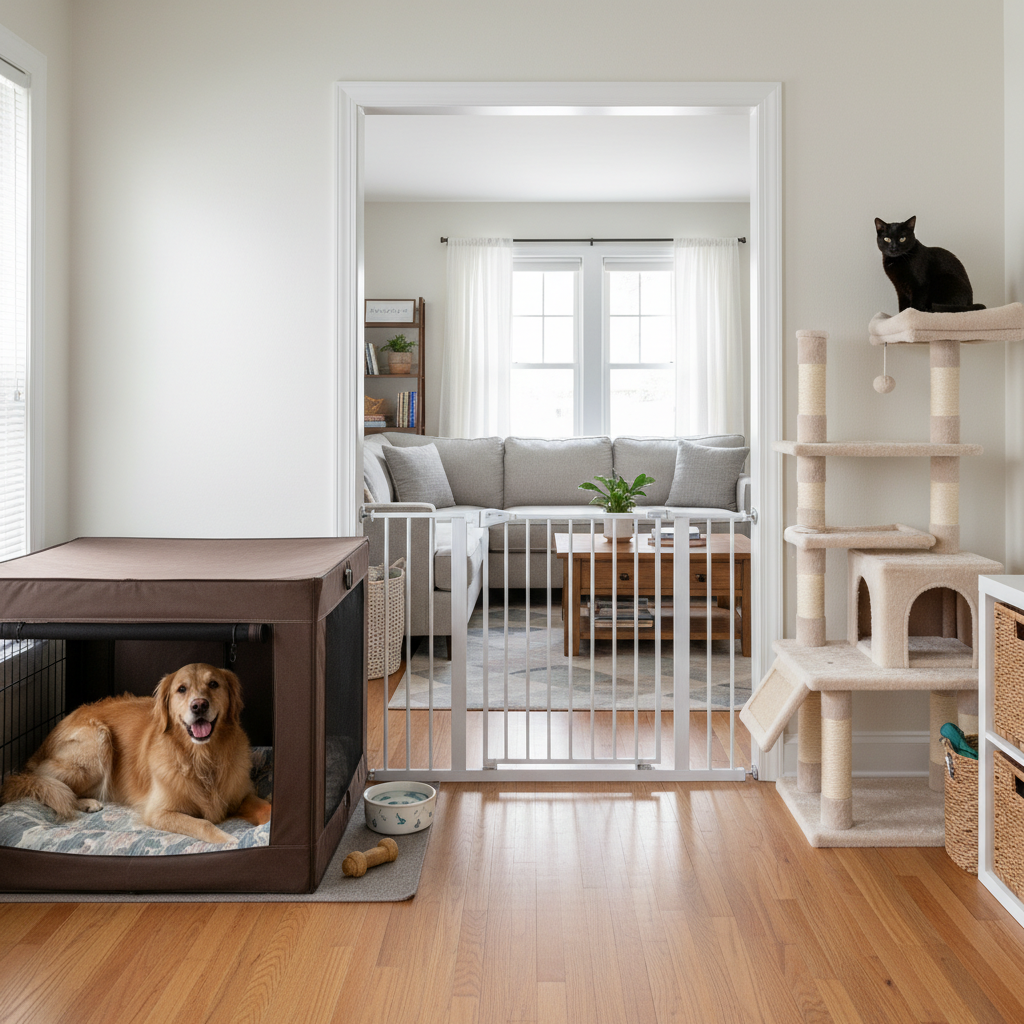
- Baby Gates: These are your best friends. Use sturdy, pressure-mounted or hardware-mounted gates to create dog-free zones. This allows your cat to roam parts of the house without fear. You can even find gates with a small cat door built in, giving your feline friend exclusive access.
- Crates and Pens: A crate isn’t a punishment; it’s your dog’s personal den. Crate training is essential for giving your dog a safe space to settle down and for times when you can’t actively supervise. An exercise pen can also be used to create a safe, contained area for your puppy or dog.
- Leashes and Tethers: Keep a light leash on your dog inside the house (always supervised!) during the initial stages. This ‘drag line’ allows you to gently redirect your dog’s attention and prevent a chase before it starts. You can also use a tether to keep your dog in the same room with you, but with limited range.
- Separate Resource Stations: Your cat’s resources should be in a dog-proof area. This means placing the litter box, food, and water where the dog absolutely cannot reach them. Elevating the cat’s food bowl or placing it in a room sectioned off by a baby gate is a great strategy. A dog who gets into the litter box is not only unhygienic but can cause extreme stress for the cat.
Expert Tip: The goal of management isn’t to keep your pets separated forever. It’s to prevent negative encounters while you work on building a new, positive association between them. Safety first, always.
Step 1: Building Positive Vibes Through Scent and Sound

Dogs and cats experience the world primarily through their sense of smell. Before they even lay eyes on each other, you can start creating a positive connection through scent. This process, often called ‘scent swapping,’ is a gentle and highly effective way to introduce them indirectly.
How to Do Scent Swapping:
- Take a clean cloth or sock and gently rub it on your dog, picking up their scent from their cheeks and body.
- Place this cloth in an area where your cat likes to relax. Don’t force it on them; just leave it there for them to investigate on their own terms.
- Simultaneously, take another cloth and rub it on your cat.
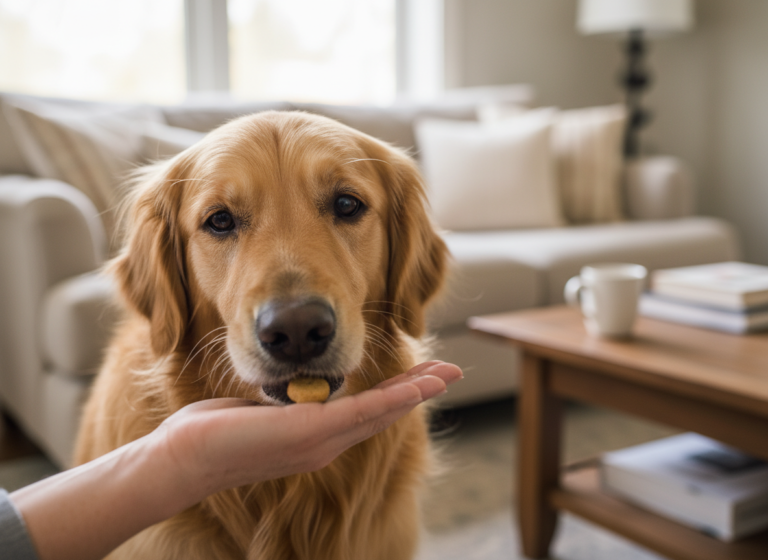
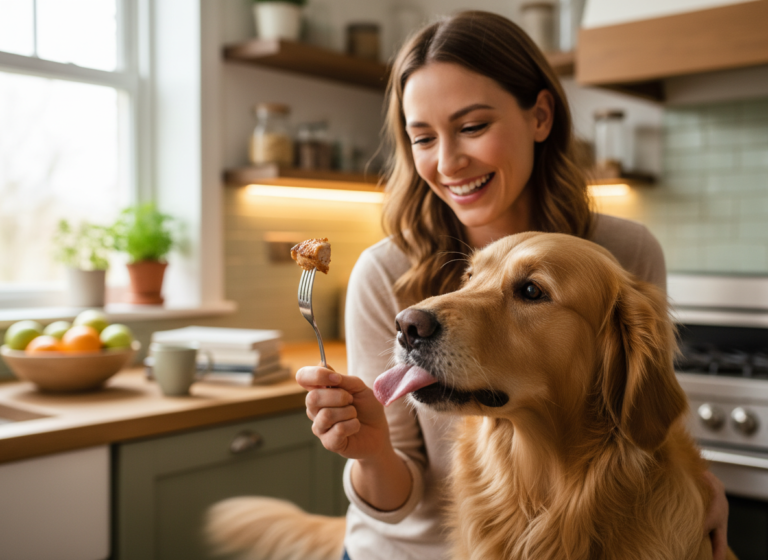
- Present this cloth to your dog. As they sniff it, praise them in a happy voice and give them a high-value treat (like a small piece of chicken or cheese).
You want your dog to think, ‘Wow, the smell of this other creature means I get delicious snacks!’ Repeat this process multiple times a day for several days. You’re looking for a neutral or positive reaction from both pets—the dog wagging its tail when it smells the cat’s scent, and the cat calmly investigating the dog’s scent without hissing or fleeing.
Incorporate Positive Sounds:
Pets are also sensitive to sounds. Let them hear each other existing behind closed doors. If the dog whines at the door, redirect them. If the cat hisses, don’t react. The goal is for the normal sounds of the other animal—a collar jingling, a meow, a soft ‘woof’—to become boring background noise.
Step 2: The First Glimpse – Controlled Visual Introductions

Once your pets are calm with each other’s scents, it’s time for them to see each other. These first few visual interactions are critical and must be short, sweet, and successful. The goal isn’t for them to meet, but for your dog to learn to be calm in the cat’s presence.
The ‘Look at That’ (LAT) Game:
This is a fantastic training game for this scenario. Here’s how it works:
- Set the Scene: Have your dog on a leash with you on one side of a room. Have another person give the cat some treats or playtime on the far side of the room, or on the other side of a baby gate or screen door. The distance should be large enough that your dog can see the cat but isn’t overly excited or fixated (this is called being ‘under threshold’).
- Mark the Look: The moment your dog looks at the cat, say ‘Yes!’ or use a clicker, and immediately give them a very high-value treat.
- Repeat: Do this a few times. The dog looks at the cat, you mark the moment, and they get a treat.
- Encourage Disengagement: Soon, your dog will start looking at the cat and then quickly looking back at you, anticipating the treat. This is the magic moment! You are teaching your dog that disengaging from the cat is more rewarding than staring at it.
Keep these sessions incredibly short—just a minute or two at first. End on a positive note before either animal gets stressed or bored. Over many sessions, you can gradually decrease the distance between them, but only as long as your dog remains calm and relaxed.
Crucial Tip: Always ensure your cat has an escape route. It should never feel cornered. A cat tree, shelf, or open door to a dog-free room gives the cat the confidence it needs to feel safe during these sessions.
Step 3: Teaching Your Dog the Golden Rules: ‘Leave It’ and ‘Place’

While general calmness is the goal, you also need concrete commands that act as your ‘off-switch.’ The two most important cues for managing a dog around a cat are a rock-solid ‘Leave It’ and a reliable ‘Place’ command.
Mastering ‘Leave It’:
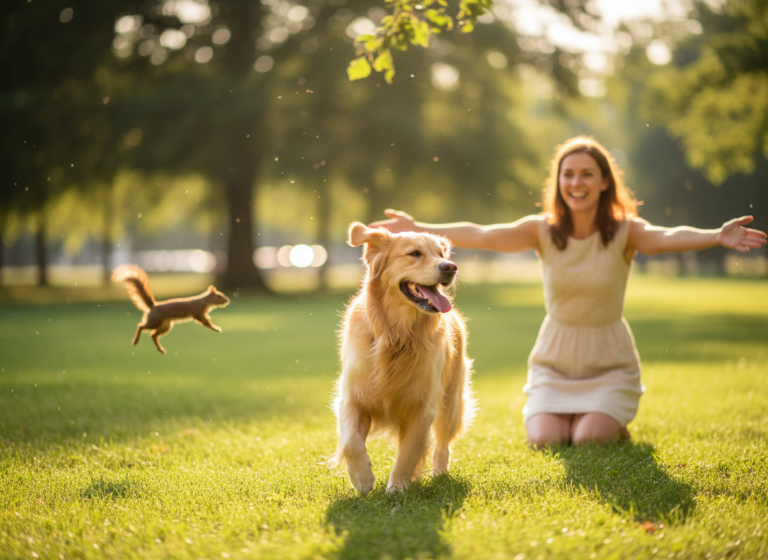
‘Leave It’ means ‘disengage from that thing immediately and turn your attention to me.’ It’s not just for dropped food; it’s for squirrels, other dogs, and yes, the cat.
- Start Easy: Place a boring treat in your closed fist. Let your dog sniff and lick. The moment they back away, even slightly, say ‘Yes!’ and give them a better treat from your other hand.
- Increase Difficulty: Progress to placing the treat on the floor and covering it with your hand. When they stop trying to get it, reward them.
- Add the Cue: Once they understand the game, say ‘Leave It’ just before they move towards the item.
- Generalize the Command: Practice with toys, shoes, and eventually, in the presence of the cat at a distance. If your dog starts to stare intently at the cat, give a calm ‘Leave It’ command and reward them generously for looking back at you.
Perfecting the ‘Place’ Command:
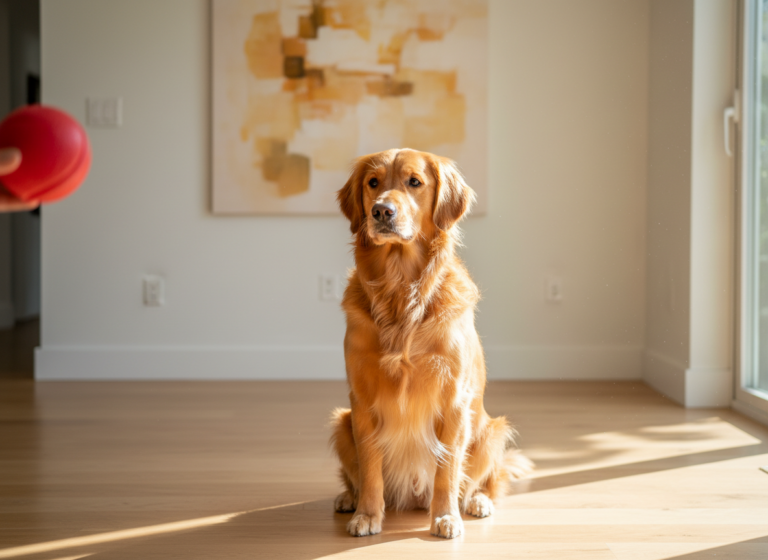
‘Place’ (or ‘Go to Your Bed’) teaches your dog to go to a specific spot and stay there until released. This is invaluable for creating calm in the home.
- Make the Place Awesome: Make their bed or mat the best spot in the house. Drop treats on it randomly and give them special chews only when they’re on their place.
- Lure and Reward: Toss a treat onto the bed and say ‘Place’ as your dog follows it. Praise them when all four paws are on the mat.
- Build Duration: Gradually increase the amount of time they have to stay on the mat before getting a reward. Start with just a few seconds.
- Add Distance and Distractions: Start asking them to go to their place from further away. Once they’re reliable, practice while the cat is in the room at a safe distance. This teaches your dog its job is to relax on the mat, while the cat’s job is to do… well, whatever it wants.
Troubleshooting Common Setbacks and Reading Body Language

Even with the best training plan, you might hit a few bumps in the road. The key is to stay patient and know how to react. It’s also vital to understand what your pets are telling you through their body language to prevent situations from escalating.
Common Problem: The Chase Is On!
The Situation: Despite your best efforts, your dog breaks management and chases the cat.
The Solution: First, don’t panic or yell, as this adds more frantic energy. Calmly and quickly separate them. Assess what went wrong with your management—was a gate left open? Was the dog off-leash when they shouldn’t have been? Re-secure the environment and take a step back in your training. Go back to short, leashed sessions at a greater distance. A chase is a huge self-rewarding jackpot for a dog, so you need to be extra vigilant to ensure it doesn’t happen again.
Common Problem: Obsessive Staring and Stalking
The Situation: Your dog isn’t chasing, but they are fixated, staring intently, sometimes with a stiff body or a low, slow-wagging tail.
The Solution: This is a sign your dog is ‘over threshold,’ meaning the situation is too intense for them to learn. You need to interrupt this behavior immediately. A cheerful ‘Oops, let’s go!’ and leading them away for a fun game of ‘find the treats’ can redirect their brain. The staring means you’ve moved too quickly; increase the distance between the pets in your next session.
Understanding Canine and Feline Body Language
Learning to read your pets is like having a superpower. Here’s what to watch for:
| Signs of Stress in Dogs | Signs of Stress in Cats |
|---|---|
| Lip licking, yawning, ‘whale eye’ (showing whites of the eyes) | Tail flicking or thumping, ears flattened or turned back |
| Stiff body, tense mouth, furrowed brow | Hissing, growling, spitting |
| Panting when not hot, whining | Crouching low to the ground, dilated pupils |
| Freezing and staring intently | Hiding, trying to flee |
If you see any of these signs, it’s time to end the session and give everyone a break. Pushing them through stress will only create negative associations.
Conclusion
Creating a peaceful home where your dog ignores your cat is not an overnight process. It’s a journey that requires patience, consistency, and a deep commitment to positive reinforcement and safety. Remember the core principles: manage the environment to prevent failure, create positive associations, and teach your dog alternative behaviors.
There will be good days and days where you feel like you’ve taken a step back. That’s completely normal. The key is to celebrate the small victories—the moment your dog chooses to look at you instead of the cat, the first time they lie down calmly on their mat while the cat walks by. These are the building blocks of a lasting peace.
By following these steps, you’re not just training your dog; you’re acting as a fair and kind leader for your entire furry family. You’re teaching them the rules of a respectful coexistence, and the result—a quiet home where everyone feels safe and relaxed—is one of the most rewarding experiences a pet owner can have.