Have you ever watched your dog intently “herd” other pets, toys, or even your kids around the house? That natural instinct is powerful, especially in herding breeds like Border Collies, Australian Shepherds, and Corgis. But what if you don’t have a flock of sheep in your backyard? Enter Treibball (pronounced “Try-ball”), the fantastic dog sport that channels that herding drive into a fun, low-impact, and incredibly rewarding game!
Treibball, which means “push ball” in German, is sometimes called “urban herding.” The game is simple in concept: your dog herds a number of large exercise balls into a goal, guided by your cues. It’s a perfect blend of problem-solving, physical activity, and teamwork. Unlike more high-impact sports, Treibball is easy on your dog’s joints, making it suitable for dogs of many ages and sizes.
In this guide, we’re going to walk you through everything you need to know to get started. From the essential gear to the foundational skills and a step-by-step training plan, you’ll be well on your way to enjoying this amazing sport with your canine companion. Get ready to unlock a new level of communication and fun with your best friend!
Gearing Up for Treibball: What You’ll Need
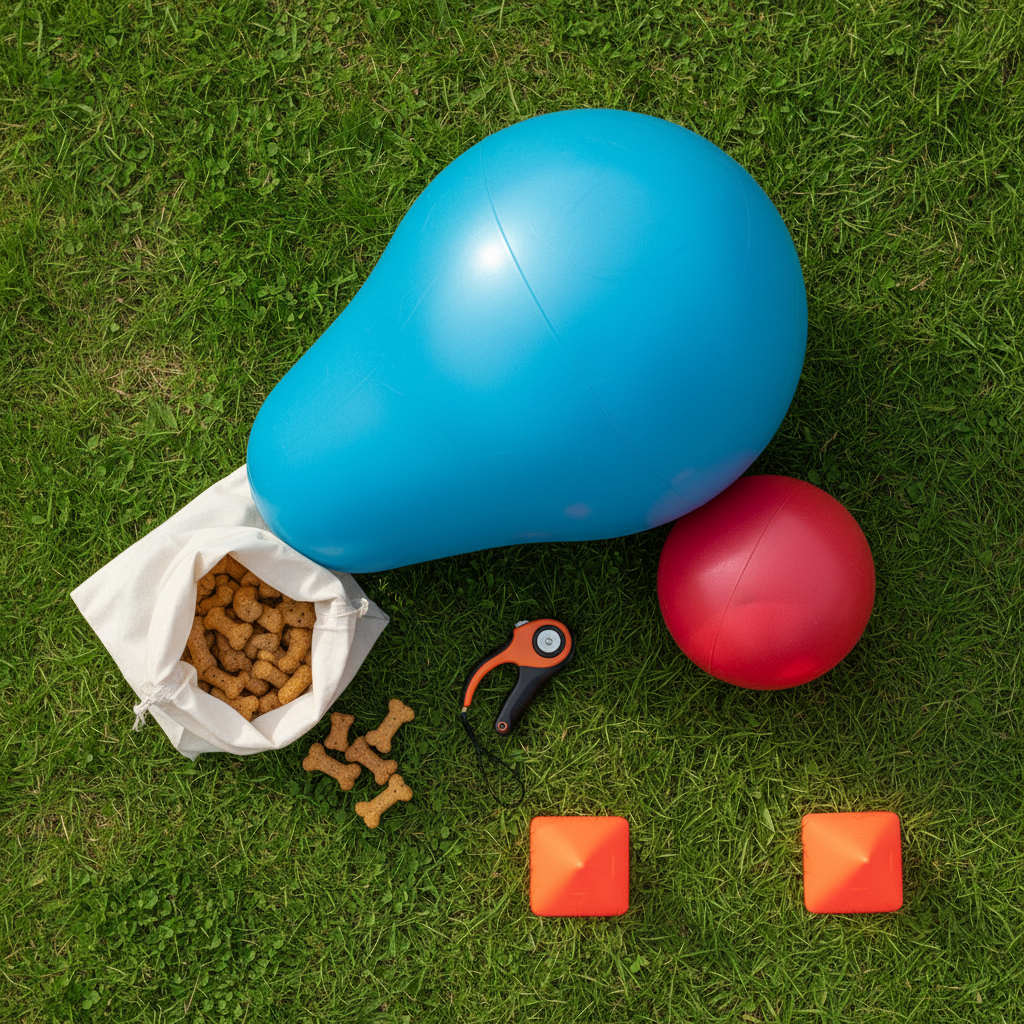
Before you and your pup can start pushing balls around the yard, you’ll need to gather a few key supplies. The great news is that you don’t need a lot of expensive or specialized equipment to begin. Here’s a simple checklist to get you started:
- Exercise Balls: These are the “sheep” of Treibball! It’s best to start with a ball that is at least as tall as your dog’s shoulder to discourage them from trying to bite or “alligator-mouth” it. A standard 65cm yoga or exercise ball is a great starting point for most medium to large dogs. You might want a smaller one for a smaller breed. It’s also a good idea to have a few on hand as your dog gets more advanced.
- High-Value Treats: Treibball is a thinking game, and you’ll want to reward all that mental effort. Use extra-special treats that your dog absolutely loves and doesn’t get all the time. Think small, soft, and smelly—like tiny pieces of cheese, chicken, or commercial training treats.
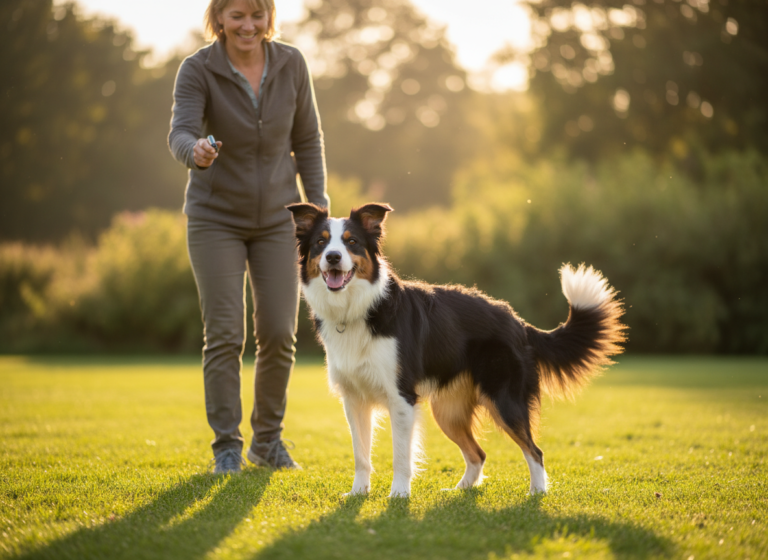
- A Clicker (Optional, but Recommended): A clicker is a fantastic tool for marking the exact moment your dog does something right. This precision helps your dog understand precisely what behavior earned them the reward, which can speed up the learning process significantly. If you’re not using a clicker, you can use a consistent verbal marker like a sharp “Yes!”
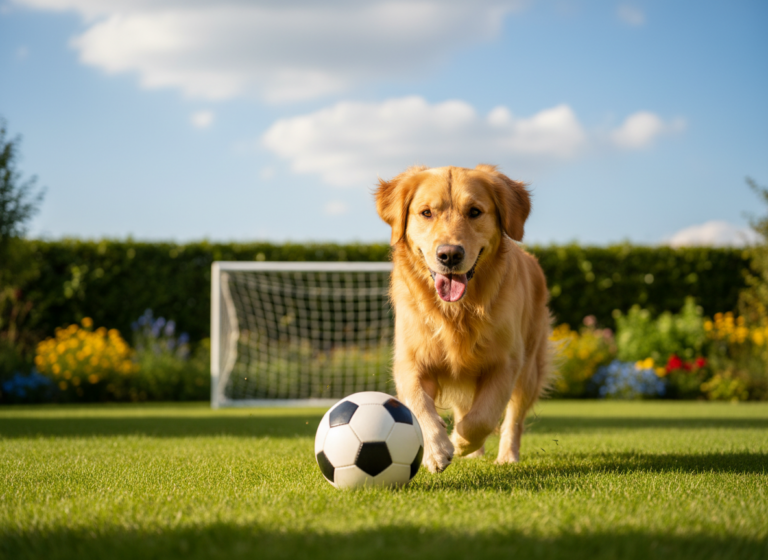
- A “Goal”: This doesn’t need to be fancy! A regulation soccer goal is perfect if you have one, but you can easily create a goal with two cones, two laundry baskets, or even just a designated space between two trees. The goal should be about 8-10 feet wide to start.
- An Open, Safe Space: You’ll need a decent-sized, securely fenced area to practice in. A backyard or a quiet park (during off-hours) works well. A relatively flat, grassy surface is ideal.
Expert Tip: When introducing the ball, make sure it’s slightly underinflated. A softer ball is less intimidating and doesn’t roll away as fast, giving your dog more control and building their confidence in the early stages.
Foundation First: Pre-Treibball Skills Your Dog Should Know
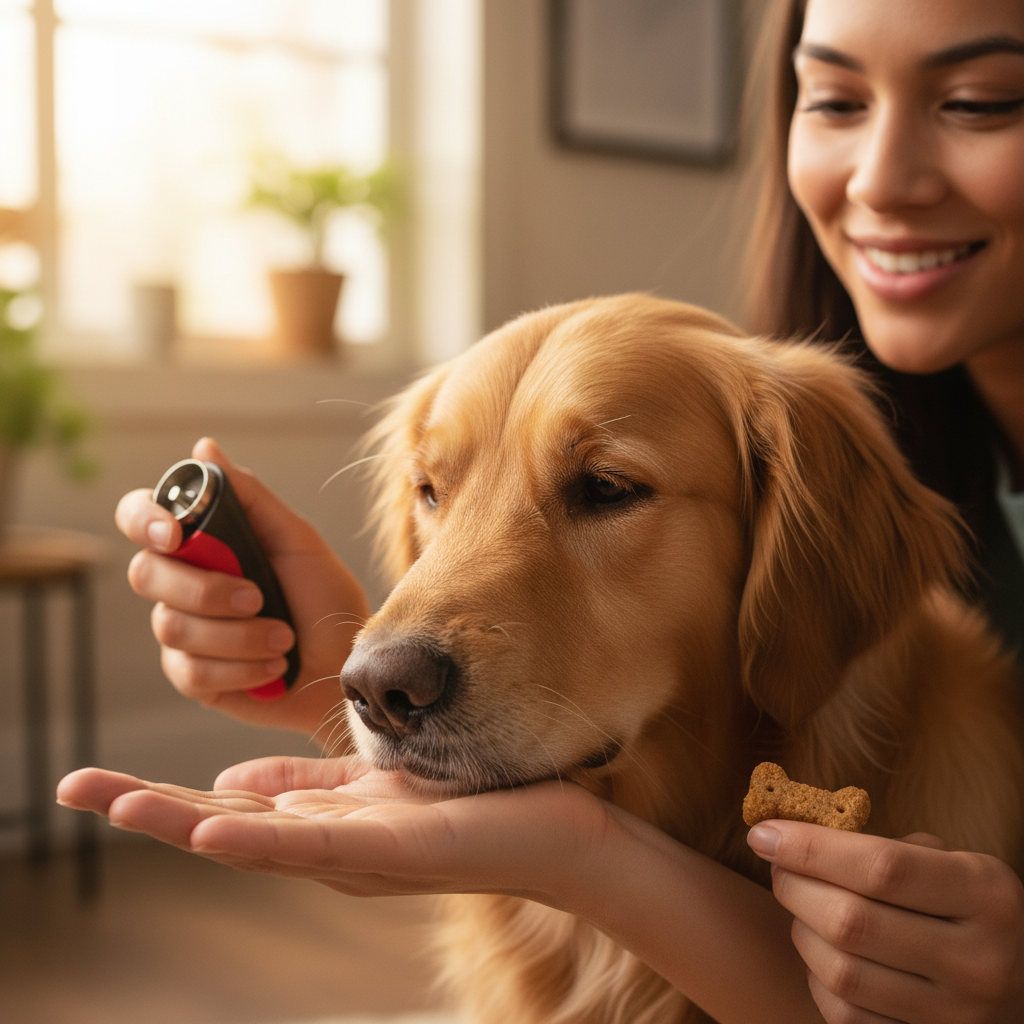
Jumping straight into pushing a giant ball can be overwhelming for some dogs. The secret to success in Treibball lies in building a strong foundation of basic skills first. Think of these as the building blocks for the game. By mastering these behaviors in a low-distraction environment, you set your dog up for a smoother, more positive learning experience.
Nose Targeting (“Touch”)
This is arguably the most critical foundation skill. You’ll teach your dog to touch their nose to a target, which will eventually be the ball.
- Hold out your flat palm to your dog. The moment their nose touches it, click (or say “Yes!”) and give them a treat.
- Repeat this, gradually moving your hand to different positions—low, high, to the side—so your dog learns to seek out the target.
- Once your dog is enthusiastically booping your hand, you can transfer this to other objects, like a plastic lid or a sticky note. This will make it easier to transition the target to the big ball later.
A Reliable “Stay”
In Treibball, you’ll need your dog to wait patiently at a starting point while you set up the ball. A solid “stay” is crucial for safety and structure. Practice asking your dog to stay for increasing durations and with mild distractions before you start adding the excitement of the ball.
Enthusiastic Recall (“Come”)
Your dog needs to want to come back to you! A fast and happy recall is essential for keeping the game flowing and for guiding your dog around the field. Make sure your “come” cue is always associated with wonderful things, like treats, praise, and play.
Sending to a Target (“Go to Mat”)
This is a slightly more advanced but incredibly useful skill. Teaching your dog to go to a specific place, like a mat or a towel, and wait there will eventually help you send them “out” behind the balls. This gives you directional control, which is the heart of herding.
Remember: Keep these initial training sessions short and sweet—just 5-10 minutes at a time is perfect. End on a positive note while your dog is still eager and engaged. This builds a love for the learning process!
The Step-by-Step Guide to Pushing the Ball
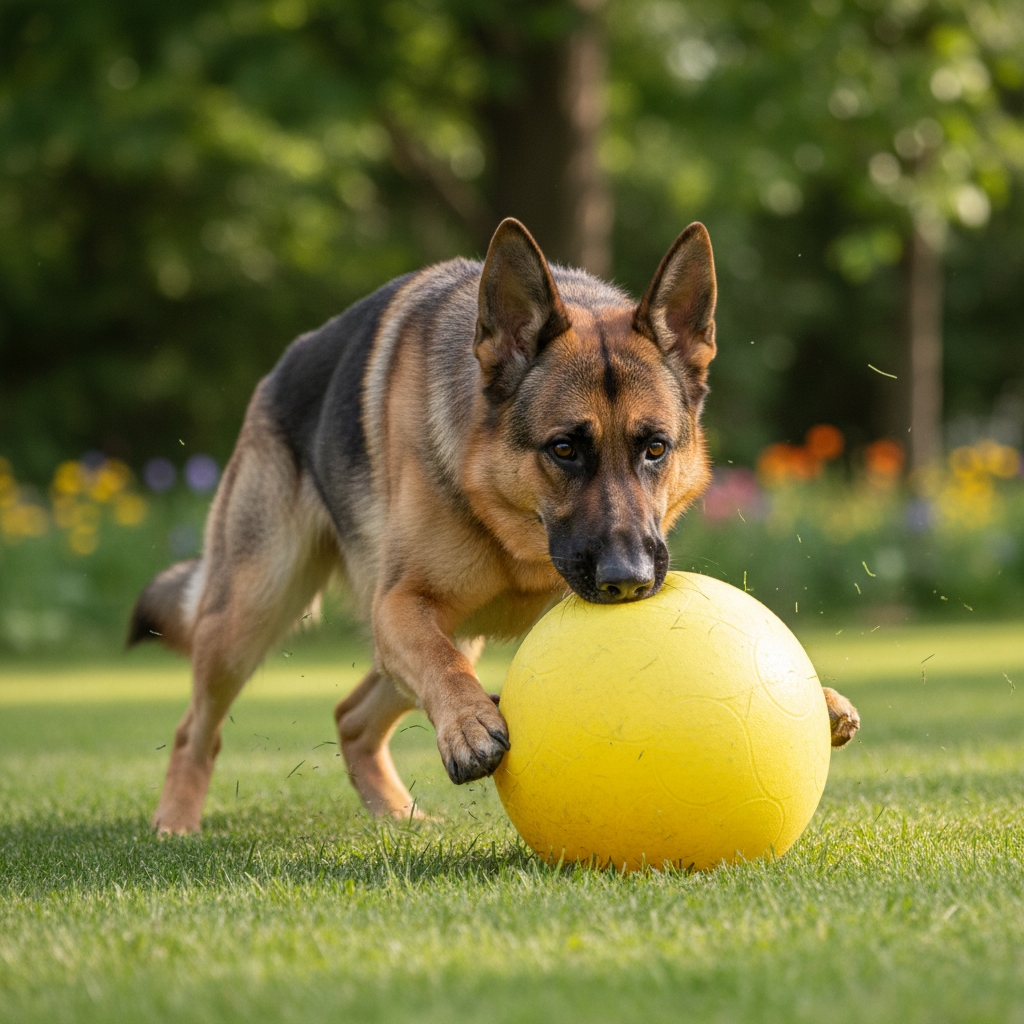
Alright, you’ve got your gear and your dog has some solid foundation skills. Now for the main event! The key here is patience. We are going to shape the behavior step-by-step, rewarding small successes along the way. Let’s get rolling!
- Step 1: Introduce the Ball.
Simply have the ball present in your training area. Don’t force interaction. Let your dog investigate it at their own pace. Click and treat any calm curiosity—a sniff, a glance, or just calmly being near it. For a nervous dog, this phase might take a few sessions. We want the ball to be a normal, non-scary part of the environment. - Step 2: Transfer the Nose Target to the Ball.
Now we connect the “touch” command to the ball. Hold your hand against the ball and ask for a “touch.” When their nose touches your hand (and by extension, the ball), click and treat. After a few successful reps, remove your hand just before they touch it, so their nose makes direct contact with the ball. Click and treat for this! This is a huge milestone. - Step 3: Encourage a “Push.”
Once your dog is confidently targeting the ball, we want to shape that gentle touch into a more meaningful push. Delay your click for a split second. Your dog, wanting the reward, will likely press a little harder. The moment the ball moves even a tiny bit from their nose-press, click and have a jackpot party—give several treats and lots of praise! This teaches them that making the ball move is the goal. - Step 4: Introduce Direction.
The goal is to push the ball towards you. Position yourself so that the ball is between you and your dog. When they push it, it will naturally roll toward you. Click and treat enthusiastically. If they push it sideways, simply reset and try again. Your body position is the guide. You can also use the goal you set up. Sit in the goal and reward any push that sends the ball in your direction. - Step 5: Add Distance and a Verbal Cue.
Gradually start adding distance. Place the ball a few feet away and encourage your dog to go to it and push it towards you. Once your dog is reliably offering the behavior, you can add a verbal cue like “Push” or “Drive” right as they are about to make contact with the ball. - Step 6: Work Around the Clock.
To gain full control, your dog needs to learn to push the ball from any angle. Imagine the ball is a clock face. So far, you’ve been at the 6 o’clock position, pushing the ball towards 12 o’clock. Now, practice guiding your dog to push from the 3 o’clock and 9 o’clock positions. This is the beginning of teaching them to steer. Use your body and hand gestures to guide them to the side of the ball before they push.
This process takes time, so celebrate every small step of progress. If your dog gets stuck, just go back to the previous step where they were successful and work from there. The goal is fun, not perfection!
Troubleshooting Common Treibball Challenges
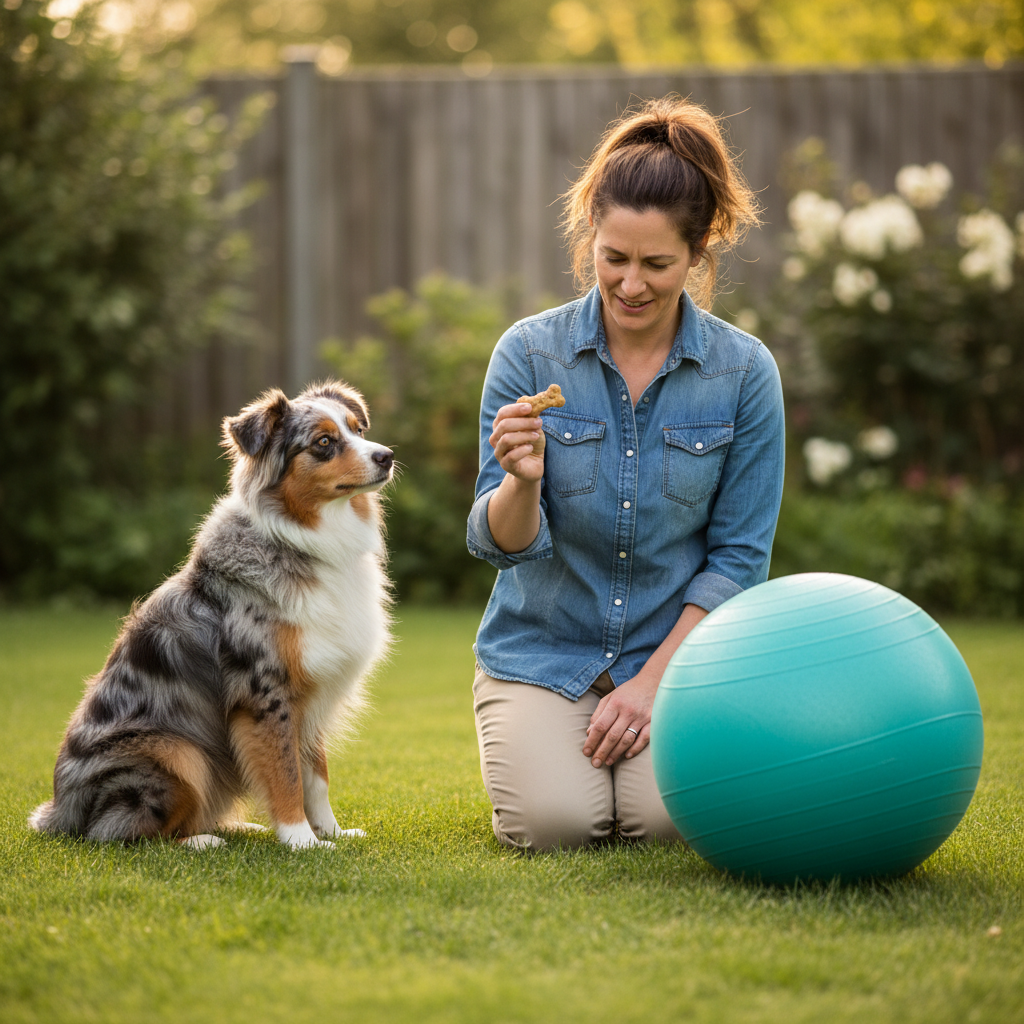
Every training journey has a few bumps in the road. Don’t get discouraged! Here are some of the most common challenges new Treibball teams face and how to work through them with patience and positive reinforcement.
“My dog is scared of the giant ball!”
This is very common. The ball is big and weird! The key is desensitization and counter-conditioning. Go back to Step 1 of our guide. Leave the ball in the room or yard and ignore it. Reward your dog for just looking at it. Then for taking a step towards it. Then for sniffing it. You can also place high-value treats around the base of the ball for your dog to find. The goal is to change the association from “scary monster” to “fun treat dispenser.”
“My dog keeps trying to bite or paw the ball.”
Herding dogs often want to use their mouths, and other dogs may want to use their paws. We need to teach them that only nose-contact earns a reward. If your dog paws or bites, simply say “Oops!” and briefly withhold the reward. Reset and ask for the nose target again. Make it super clear that the nose-boop is what gets them the good stuff. Using a slightly larger ball can also help discourage biting.
“My dog loses focus and gets distracted easily.”
This is a sign that your training sessions might be too long or the environment is too distracting. Keep your sessions short—even just 3-5 minutes can be very productive. Always aim to end on a high note, before your dog checks out. Also, make sure you are using treats that are exciting enough to hold their attention. If you’re training outside, start in a low-distraction area before moving to a busier spot.
“My dog just pushes the ball randomly, not towards me.”
Directionality is tricky! This is all about your positioning. Make it incredibly easy for your dog to succeed at first. Stand very close to the ball, directly opposite your dog, so a push of any kind sends it right to your feet. As your dog gets the idea, you can slowly add distance. You are the magnet; the ball is the piece of metal your dog is pushing toward you.
A Golden Rule: If your dog is failing more than they are succeeding, the task is too hard. Take a step back in your training plan to a point where they can be successful, and build up more slowly from there. Training should build confidence, not frustration.
Taking It to the Next Level: Advanced Treibball
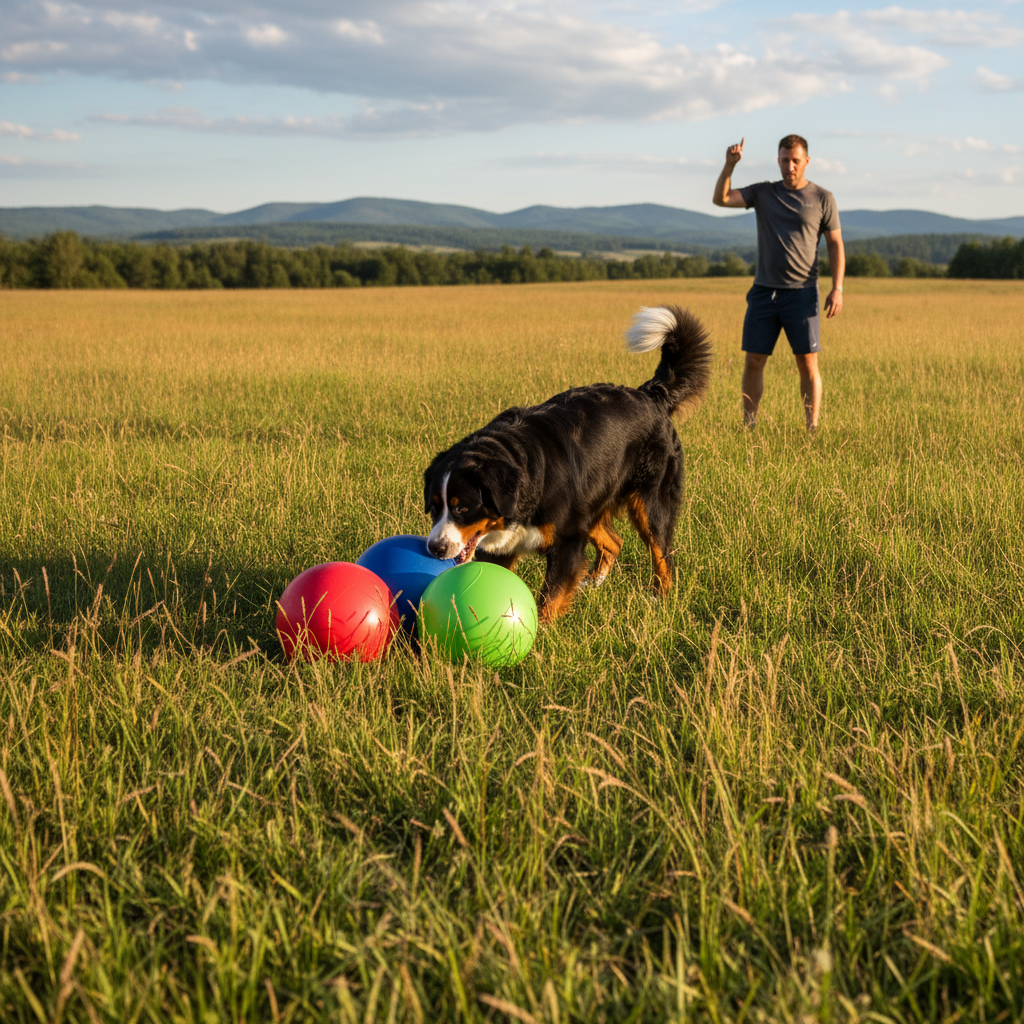
Once your dog has mastered the art of pushing a single ball into the goal on cue, a whole new world of Treibball fun opens up! This is where the game truly starts to resemble herding and your communication as a team will shine. Here are a few ways to level up your game:
Introducing Multiple Balls
Start by placing two balls out in the field. At first, they can be close together. Send your dog to push one, and then after they score, send them for the second. Gradually, you can increase the number of balls (the standard in competition is eight) and spread them farther apart in a triangle formation, similar to a game of pool.
Directional Cues and Distance Work
This is the heart of advanced work. You’ll want to teach your dog to go “out” and get behind the group of balls, then wait for your cue to bring in a specific one. This involves teaching verbal or hand signals for directions:
- “Out” or “Go On”: A cue to send your dog running out and around the back of the balls.
- “Left” and “Right” (or “Come Bye” and “Away”): Cues to tell your dog which way to circle behind the balls to line up with the correct one.
- “Wait” or “Lie Down”: A cue for your dog to pause behind the balls and wait for your next instruction.
These are complex skills that require a lot of practice, but it’s incredibly impressive to watch a dog working off its handler’s cues from 50 yards away!
Joining a Class or Finding a Community
If you and your dog are truly loving the sport, consider looking for a local Treibball class or club. Training with an experienced instructor can help you refine your technique and troubleshoot problems. Plus, it’s a wonderful way to connect with other people who are passionate about dog sports and share in the fun and camaraderie.
Whether you decide to compete or just enjoy the game in your own backyard, the real prize in Treibball is the strengthened bond and deeper level of communication you build with your dog. It’s a beautiful dance of teamwork and trust.
Conclusion
You now have all the tools and steps you need to begin your Treibball adventure! More than just a game, Treibball is a fantastic way to provide mental and physical enrichment that satisfies your dog’s innate instincts in a safe and positive way. It builds incredible focus, teaches impulse control, and creates a language of communication between you and your dog that will translate to all other aspects of your life together.
Remember, the journey is the destination. Be patient with your dog and with yourself. Celebrate the small victories, laugh at the goofy mistakes, and cherish the moments of perfect teamwork. Every training session is an opportunity to strengthen your bond.
So, grab an exercise ball, a pocketful of treats, and get out there. It’s time to discover just how brilliant your canine partner is. Happy herding!